free web stats
ThereAndBackAgain

Monday, March 2, 2009

A Week in the Park?


After having such a good time two weeks ago it's time to try a whole week in the Everglades. The biggest challenge is carrying all the fluids that I need. At least the trip home will be lighter. If I'm lucky I might see some of the WaterTribe's Everglades Challengers while I'm out there. A trip report will follow in two weeks.

Thursday, February 19, 2009

A Weekend in the Park

I finally got out for a few days and went into Everglades Nat'l Park. I never would have thought that President's Day weekend was one of the busiest times of the year at the Park. Selecting the campsites that I wanted wasn't going to work. The Park Staff kept saying, "taken", in reply to my requests. After a few minutes I realized that my initial float plan was going to have to be revised. I was taking a friend out who had never paddled in the Park and thought of 10-15 mile days as long hard paddles. This made our options all the fewer.

I'm normally a solo paddler. When I get to a campsite there isn't any socializing or camaraderie so I normally stay on the water for a much longer part of the day covering more miles. This trip was a nice break from my regular routine. It was enjoyable getting off the water before dark and being able to set up camp in the light. We even had to share space the first two nights with other adventurers and the story telling was fun.

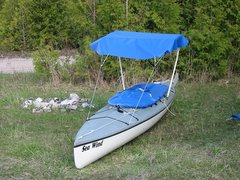
Another interesting side note: People recognize the "WaterTribe". Other paddlers would see the lettering on my Sea Wind and instantly comment on either the WaterTribe or Team Kruger. It seems that almost anyone who is paddling in the Everglades Nat'l Park has heard of that crazy group of paddlers known as the WaterTribe. It kind of makes you proud to be a small part of such a great group.

Monday, February 9, 2009

Slowly getting back into the swing

After last years challenge I had stopped paddling for almost 10 months. My New Year's resolution was to get back out on the water. Paddling is the primary way that I keep in shape. Over the period of inactivity I gained well over thirty pounds. So far this year I've lost 22 of those pounds. Now they're coming off slower. I just need to go slow and keep at this life style change. So far this year I've gotten in just over 400 miles, 1/2 of them in the Kruger.

I got out this weekend for my first overnighter. I thought that I'd spend more time out but got discouraged with the wind, tide and temperatures. I also need to make a couple more changes to my sleeping arrangement in the Sea Wind. I have a couple of ideas that I'll share if they pan out.


The best part of this weekend's paddle was that I got a few photos of a bobcat. I've seen them a few times before but never had my camera ready. Also, the last couple of weeks I've been seeing wild boars out on the mangrove islands.


Thursday, February 5, 2009

And Now, The Rest Of The Story

So the story in the post below was from Monday. My life was never in danger. What was in danger was my pride and equipment. How could this have all been avoided? What led up to flipping a Kruger in less than Extreme conditions?

It all started the day before. I had been out sailing with my Balogh/BOSS system for about 18 miles when I had decided to take it down and paddle the last 7 miles home. I have places to store this all securely but had just set it on the floor in both the front and rear of the Kruger. I was going out Monday and I didn’t know if I’d be using the Balogh or the PAS (Pacific Action Sail) so I just left the Balogh on the floor over night. This was the first mistake.

The second cause leading to this educational experience was that I never “snapped” my spray skirt into place. I was way too over confident that I would ever be flipped. I’ve paddled in much worse conditions and never with incidence. The skirt could have been secured if I had just taken the 1 to 2 minutes to snap the 8 snaps down.

Next, I have an 8 gallon air tight/water proof box placed behind my seat with personal items and electronics. I have tie downs in place on both the box and in the Kruger to keep it securely in place. Again, I didn’t take the time to tie it in. I couldn’t imagine a situation where it would have mattered.

Another point is that I wasn’t wearing a PFD. It was placed in front of me, PLB in one pocket and flares in another, up in front of other gear and all my diet Coke.

The last point, I believe my Kruger could use a little additional flotation.

So this is what led up to the inability to self rescue after flipping. I have always thought of myself as being capable of self rescue in much more extreme circumstances than this and it was a very humbling experience. I am blessed to have had this learning experience in the near civilization conditions that I did rather in some WaterTribe Challenge scenario.

Now I’ll explain why the 8 gallon dry box has to be tied down. Once my Sea Wind filled with water the box acted like a large bobber. It kept bobbing up, slamming into the spray skirt. After a few hard hits it would rip the skirt free. I would tuck the box back in and stretch the skirt back on. This went on a few times before I concluded the box had to go. I grabbed a line and tied the box to the Kruger, letting it float 10 feet off.

As the water swished back and forth in the boat any other item that floated made their way from front and back to the center where the spray skirt was open. My mast and lee board from the Balogh system kept trying to escape. I kept pulling them back in as lesser objects (diet Coke and gloves) did get away.

I hadn’t gotten to a point of giving up quite yet when the commercial fishing boat approached but I was realizing that self rescue was looking hopeless, unless I was willing to let anything and everything float away. I wasn’t willing to let about $3000 of gear get away. I was just then thinking about my options to call for help myself, Smoke, Cell Phone, or VHF? It wasn’t going to be SPOT or PLB!

In reflection; it’s one thing to go out on protected water in an empty boat, flip it, and recover. With a PFD on you can even lift the boat upside down out of the water and drain most of it before flipping back upright. Not so with a boat full or another 50, 100, or 200 lbs. of gear. If I had placed a full expedition load in the boat would it have displaced enough water to have kept it from sinking down so close to the surface? I don’t know but need to find out. In the weeks to come I will develop a method for self rescue even in extreme conditions. I now realize that when conditions are bad (ex. 5 foot wave) the boat is going to take on substantial water if you flip. I need to know that I can right the boat and pump it out in those situations. I’ll keep you posted as I discover what works for me!

An Eye Opener

Hey all,

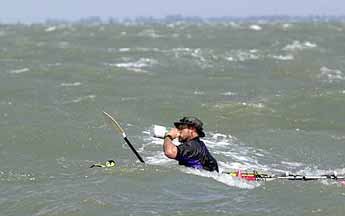
First the good news, no Coast Guard involved. So there I was when a sudden gust of wind hit my sail, moments later I realized I was upside down and the boat wasn’t making any progress so I decided to do something different. After exiting the boat in the ripping tide I realized that a sail sticking straight down isn’t a good thing when trying to right a boat. After trying a couple of times to bring the Kruger back upright I decided that I would have to go to the other side so that the wind would catch the sail and aid me with righting the boat. If only the wind would have stopped at that point it wouldn’t have continued rolling all the way back over. At this point I watch as my paddle floats away but think that as soon as I get the boat upright and pumped out I’ll go find it. OK, I finally get the boat blue side up and strap the sail down so it isn’t catching the wind. I get out my pole that I put a paddle float on and dig for my float. By this time the Kruger is 110% full of water and is actually floating just below the water level. There is no way to pump out the boat because the water runs in quicker than it can be pumped out. I try swimming for shallow water. That was funny. I’m slowly going out to sea. Now every thing in the Kruger is starting to get sucked out of the boat by the pounding chop and wind. My only concern now is not loosing a thousand or two dollars worth of gear. As I’m floating hopelessly I realize that there sure aren’t any boats out today! Oh wait, here comes a large commercial fishing boat. Oh wait, there goes a large commercial fishing boat. Oh cool, they’ve felt guilty passing me by and are returning. Now a quick side note. A Kruger has over 200 gallons of capacity. Quick math; 200 x 8 = 1600 lbs. My Kruger with this much water in it weighs over ¾ of a ton. After trying to help they realize there’s nothing they can do. They spot my SPOT on the back of the boat and tell me to activate it. NO WAY, I tell them. This isn’t life threatening, yet. So they say they’ll call the Coast Guard. I’m still not happy with that option. I ask them just to call County Sherriff or Naples Police and they do before taking off. There I float, trying to keep everything together. Ah, the first lights and sirens, Fish and Wildlife to the rescue. The wind and tide are strong enough that it takes over five minutes to get me a line. By this time more lights and sirens. Naples Police are now there. To make a long (long) story short they towed my over ½ a mile back to the ramp. I wouldn’t get out of the water. The spray skirt on the Kruger would come off if I let go of it and I wasn’t willing to lose anything else. So there I was, hanging on to my boat, holding the skirt on, tucking things back in as they floated out, being towed through the frigid water back to dock. Both agencies helped me get things together and load my boat on the trailer. Now I have to go rinse a whole lot of stuff. More stories later.

Ttyl,
Dexter the Manatee

Monday, January 12, 2009

Perseverance more important than Endurance

The last three Everglades Challenges have taught me something. It doesn’t matter what your physical condition is or how much endurance you have; without perseverance you won’t make it. The Everglades Challenges are as much about your mental state of mind as they are about the physical aspect.

When I signed up for this year’s Challenge I mentioned that I hadn’t paddled for nine months. I normally paddle at least 3000 miles a year. Last year (2008) I paddled less than 1000 miles! Over a 40 week period I gained about 30 pounds. So far this year I’ve lost a solid 10 of those pounds. All it takes is eating less and paddling more.

Later this week I need to take a day or two off of paddling. It’s time to get the Kruger back into shape as well. I have a list of about a dozen things that needs to be done in order take the Sea Wind back out. So far this year all I’ve been paddling is my whitewater boat. It’s time to get comfortable in all weather conditions in the Kruger. Over night trips are just around the corner.

Tuesday, January 6, 2009

Getting Ready To Become Active Again

Stay tuned for updates and stories of my adventures. If I'm going to be listed as a part of TEAM KRUGER then I better start paddling like I am!